Showing posts with label dinner. Show all posts

Sunday, October 2, 2016

Crottins de Chavignol Chauds en Salade - Hot Baked Goat Cheese with Greens


One of our daughter's favorite dishes is hot baked Crottins de Chavignol served on a piece of toast along a plain salade verte. Crottins are small round-shape goat hard cheese. The most famous ones come from Chavignol - a small village near Sancerre in the Loire Valley. 
France (and Europe) being very strict as to protecting regional products and savoir-faire,  the crottins can only be called Crottins de Chavignol is they are actually coming from the Chavignol area.  They are protected by what we call an Appellation d'origine contrôlée (AOC) which is a French certification granted to certain French geographical indications for winescheesesbutters, and other agricultural products that come from certain terroirsOther areas in France produce crottins  de chèvre - they are just not labeled "de  Chavignol". 
We grew up eating crottins de chèvre chauds either as an appetizer or a lunch/dinner entree  They are an easy-to-choose-easy-to-make affordable dish that pleases most cheese lovers. For those of you who have traveled to France, they are generally on many casual restaurants, served on a slice of toasted Pain Poilâne (or any other pain de campagne if pain Poilâne is not available.)
Unfortunately, this is one of the dishes I hardly make in the US. Much to my family's regret. Reason? Price of the crottins. In France, you could purchase crottins de chèvre for less than 1 euro each (2 euros if you want them organic or de Chavignol), while in the US, I find them at at least $5/piece for locally-made cheese. What is an affordable entree in France become luxury across the Atlantic! 
We therefore serve them on special occasions only (or when they go on sale, which is to say... rarely.) 
As a result, whenever we go to France, our daughter makes sure to eat a lot of them, always volunteering to help prepare them whenever she can! I think that if we were not living in an apartment building in the center of Philadelphia, she would try to get a goat to make her own crottins! If you have access to crottins where you live, please try to make this salad. You would not be disappointed! Bon Appétit!


Ingredients
- 1 (or half) a crottin per person
- 1 (or half) of wholewheat bread
- Olive oil
- Salt & pepper
- Thyme/Rosemary (optional)


  • Put the crottin on a slice of bread with rosemary/thyme on top
  • Pour some olive oil on the crottin and the bread
  • Bake in the oven under the High Grill for 5 minutes (or more depending on the power of your oven; you want the crottins to start melting but the bread should not be burnt)


Friday, August 5, 2016

Tarte au thon de l'été


Don't ask me what I did these past few months.... I did cook a lot but never managed to bring it to this blog. My apologies! Fortunately, Summer being in full swing, we all have a little bit more time to cook and experiment.
My nephew from Marseille came to spend the month of July with us in Philadephia to attend a ballet camp. Since our children were in France for their Summer-long vacances and that my husband joined them, C. and I ended up spending most of July together. Apparently, he was worried that spending time with his gluten-free vegan aunt, he was going to eat "des graines" everyday! My worry was that because of him spending time in the US, he would fall victim to the double-frappuccinos, supersized French fries and other double-cheeseburgers!!! At the end, it was a balance of easy-to-eat French and US food. We had vegan and beef hamburgers, blue corn tortilla chips (a lot!) and haricots verts (beaucoup), salade verte and Sweet Potatoes Fries....
One evening, C. suggested to make this Tarte au thon that my sister-in-law and many of my friends cook in France this time of year. We used the Marmiton recipe (for those of you who want the French version) and C. found it very tasty. I will definitively make it again for our family when they are all back from France. Until then, I would encourage you to try it! Served with a salade verte, it makes the easiest Summer dinner.
Bon Appétit!

Ingredients:
 - 1 pie dough (in France, people tend to use the puff pastry one; since I don't always have some handy, I generally make a pâte brisée)
- 2 cans of tuna (in water, no salt added)
- 2 small tomatoes
- 3 tablespoons Dijon mustard
- 2 eggs
- 20 cl light cream
- 3 tablespoons milk
- Add salt and pepper to taste
- Swiss cheese (optional)


  • Pre-heat the oven to 400F
  • Lay the dough in a deep pie dish.
  • Spread the mustard
  • Spread the tuna
  • Slice the tomatoes and lay on top of the tuna
  • In a bowl, beat the eggs and add the creme fraiche and milk
  • Add salt and pepper to taste
  • Pour the batter onto the tomatoes and tuna
  • Add the cheese if using some
  • Cook in the oven for 40 minutes


Sunday, July 19, 2015

Poulet a l'estragon - Tarragon Chicken


It's Summer again and with it come all the herbs to spice up dishes! We grow a few on our rooftop - we gave up on cilantro and parsley because we eat so much of them that it's not "space-efficient". To much of my regret, we don't grow chervil either because it's too fragile. We therefore tend to have thyme, oregano, sage, basil, rosemary, chives, tarragon as well as mint. This year our tarragon is really enjoying the warm and damp weather - trying to move in with the oregano in the next pot!

My paternal grand-parents had a huge (OK, maybe not HUGE but it did look very big to me at the time) tarragon bush in  their garden in Burgundy. There was more tarragon in this garden that we could all eat and somehow, despite long cold Winters, it always came back for us in the Summer.
We would use tarragon to flavor the sauce vinaigrette (made with Dijon mustard, évidemment!) in our salades but as well as with cooked dishes. 
At home these days, I use it in pretty much every salad I make or in some hummus or other dips that we eat for apéritif or just with the rest of the meal. I recently made this Poulet a l'estragon and would encourage you to make it if you don't know how to use the tarragon you bought the other day or that your neighbor gave you! 
There are different versions of this dish - you could omit the crème fraiche is you wanted to keep it on the lighter side or if you are serving it with green beans or other vegetables that do not call for a sauce (as opposed to rice or potatoes which is what most French people would eat it with.) Some people add tomato paste in the sauce - nothing that I remember from cooking it with my grand-mother but why not...  I will leave it it up to you do improvise... Bon Appétit!

Ingredients
- Chicken (here again, you can decide if you want to use a whole chicken cut in 1/8 or if you'd rather use only chicken breasts)
- White wine (1/2 cup or 125ml)
- Chicken stock or water (1 cup/250ml)
- Shallots (minced) - I like them a lot so I use at least 4 or 5 depending on size
- Tarragon (at least 3 sprigs and 2 Tbs chopped tarragon as well)
- Creme fraiche (optional)
- Olive oil, salt and pepper 
- Salt & Pepper


  • In a pan, warm olive oil and brown the chicken to your liking. Set aside and réserve
  • In the same pan, saute the shallots in olive oil until they are golden.
  • Add the white wine and deglace the pan. Simmer until white wine redues
  • Add chicken stock (or water)
  • Add tarragon sprigs
  • Add the chicken back and simmer until the chicken is fully cooked (you can use a lid to ensure the sauce does not all evaporate)
  • Take the chicken out and place it in the oven to keep it warm
  • Add the crème fraiche in the pan over high heat and fresh chopped taragon - stir and bring to a boil. Adjust salt and pepper to taste.
  • Pour over chicken and serve.


  • Sunday, July 6, 2014

    Filet mignon de Porc aux Raisins et au Cumin - Pork Tenderloin with Cumin and Grapes


    I was doing some "Summer Cleaning" yesterday (LOOONG overdue!!!) and part of it included getting rid of some magazines that had been piling up next to our bed. I don't purchase many magazines except for the New Yorker; I otherwise rely on my appointments here and there to catch up with past news... or to the free subscriptions I somehow receive. My husband only subscribes to professional magazines, which titles are only relevant if you are into veterinary ophthalmology research (anyone?).

    One exception are cooking magazines from France which my husband is really fond of.... He used to subscribe to one in particular when he was living in France (that was 14 years ago!) but kept an on-and-off subscription to that magazine since he moved to the US. While he has not had a subscription lately whoever comes from France knows to bring along the latest issue....
    What I noticed over the years though, is that the amount of magazines piling up/the amount of recipes indeed made is really high...  "No time, not the right ingredients, difficulty finding a recipe in all the magazines... ", any excuse is good for me to hear.  We tried to find a solution to the "recipe access" issue, sorting out some of the recipes he would most likely make and putting them in dedicated binders....  Despite all this nice filing and despite dozens of magazines later, he has made only 4 recipes (the Charlotte aux Fruits Rouges, the Creme Renverseà l'orange, a Soupe aux Fruits Rouges et à la Mascarpone and this recipe.) 4.
    My business hat tells me that 1) The magazine must be really excited about having such a loyal customer... 2) We should forget purchasing this magazine because it's a real waste of money, especially now that everything is a click-away... My supportive spouse heart actually loves having him dream in front of these recipes... but my practical head knows that I will most likely be cooking the next meals anyway (with or without a recipe from that magazine (because honestly, I am not a big fan of that cooking magazine myself)).

    He would argue that this is the same with me and the Elle à Table that I ask visitors to bring (or that I purchase while in France)... and this would be true except that I never purchase the magazines to make something; I only get them to get ideas and then improvise around because yes, I don't have time to make elaborated dishes anymore and I do lack some of the ingredients (or if they are available, what should be an affordable meal becomes very expensive....)...  and despite that, my magazines/recipes made ratio is much higher!

    One of the recipes he likes to make is this Pork Roast with Grapes and Cumin. I have come to making it myself as well (??!!) with generally great success -  it passes our children' "can-we-have-it-in-our-lunch-box-tomorrow? " test (i.e., a close to perfect score!))... and it's a relatively easy dish to make even the the night before...   so I would highly encourage you to try it out!

    In the meantime, I'll see whether we'll come back with new cooking magazines from our vacation in France! Stay tune, you never know what could be cooking soon in our family! Bon Appétit!


    Ingredients:
    - 2 pork tenderloin
    - 500 gr (1 pound) of white or red grapes
    - 200 gr (about 1/2 pound) of small pearl onions
    - 1 tbs honey
    - 30 gr (1 oz) butter
    - 1 tbs cumin seeds
    - Olive oil, salt and pepper


    • Peal the onions and reserve in a bowl
    • Wash the grapes and cut them in half. Blend about 1/3 to make a heavy juice. Reserve.
    • Salt and pepper the meat and roll it in cumin seeds (you can keep the tenderloin whole or cut them in chunks depending on the size of your cocotte)
    • In a cocotte, heat the oil and brown the meat. Once all pieces are done, add the honey and the grape juice. Cook for another 15mns.
    • In the same time, cook the onions in butter in a pan. Once they are cooked, take them out of the pan and drop the remaing grapes into it. Sautee the grapes for 5 minutes. 
    • Once the meat is fully cooked, take them out of the cocotte, and deglacez the cooking juice (scrapping the bottom of the cocotte very well) and let it cook for another 5 minutes to thicken.
    • Put the meat on a serving plate, laying the sauce over it and the onions & grapes around.
     My personal comments:
    • I generally cook the onions wih the meat and add the grapes a few minutes before serving so that they are cooked but not mushy.
    • I like to blend white & red grapes as well as white/yellow/red pearl onions.
    • I serve it with mashed carrots and/or rice.
    • You could make it with a pork roast - allow more time for cooking.


    Saturday, May 10, 2014

    Aragula Soup - Soupe à la Roquette


    Aragula ("roquette" in French) is a favorite green in our household. I don't know whether it was already common in the US in the late 80s  but I don't remember eating any in France growing up. Choices of greens for our salade verte were really limited to laitue, feuille de chêne, mâche et frisée (I promise to make frisée aux lardons one day - a favorite of my husband's but not something I ever ever enjoyed (even before I stopped eating meat)!)

    Aragula is something I really discovered in the US and have come to love (unlike iceberg lettuce).
    We could eat some everyday, especially when the other green options for our daily "salade verte"are iceberg lettuce or another unappealing romaine. 
    We eat aragula just plain with a balsamic vinaigrette, or in my home-made improvised mix-greens salad or other salade composée, on a white pizza or in a sandwich! Although it sometimes touches warm food, I had never thought about making it into a soup until I realized a few months ago that, because I was traveling a lot (hence the absence of posts since Feb! Sorry....), we were not going to be able to eat the whole aragula before it would go bad (and yes, it does go bad relatively quickly, even when we purchase it in a clamshell container (I know, I know)), I would have to come up with a soup. It was freezing cold outside (we had a LLOOOOOONG winter this year) and I figured that I could pretty much cook it in a similar way as I do the Soupe au Cresson
    Easy. Simple. Delicious. And a great success.
    To be honest, between watercress and aragula soup, I prefer watercress (if and only if, this is wild watercress (or watercress that actually tastes like watercress! (I have been disappointed sooo many times here...))... but making this aragula soup is a good alternative. Whereas the taste of aragula that can be pungent when eaten raw, it becomes milder in the warm soup - making it an easy alternative for children for instance. 
    I also think that this soup, or a slightly modified version of it, will be great served cold this Summer. Until then (I could eat hot soup every day), I know that I can go and purchase more aragula... we'll never run out of ideas (next on my list is aragula pesto (recipe anyone?)) to eat it all... Bon Appétit!


    Ingredients (for 4 persons)
    - aragula, washed and chopped
    - 3 cloves of garlic, minced
    - 1 small onion, minced
    - 2 potatoes, skin off and cubed
    - salt and pepper to taste
    - Olive oil

    • In a pot (with lid), over medium-heat, saute the onion, garlic and potato in olive oil.
    • Add about 3 cups of water
    • Put the lid on and simmer for about 10 minutes or until the potatoes are soft.
    • Immerse the aragula for two minutes
    • Blend thoroughly
    • Add salt and black pepper to taste .
    • Serve with crème fraîche, grated cheese, toasted bread.


    Saturday, August 3, 2013

    Cold Celery-Cucumber Soup


    I just came back from two (too short) weeks of vacation in France where we spent time with relatives and friends in rural Normandie, Lozère (that's in the middle of nowhere France) and the French Alps (near Annecy - a city worth visiting both in the Summer and Winter!) Needless to say that we had a great time....

    It was really hot (unusually hot for the season), which made us eat a lot of salades composées, generally made up with fresh vegetables from the potager. Spending time with friends who are lucky motivated enough grow their own vegetables in their potager (think fresh lettuce, peas,  tomatoes, fresh French beans, fava beans, zucchinis, eggplants, etc....) reminded me of my grand-mother's silly cucumbers & zucchinis!What I loved about gardening with my grand-mother in the Summer was to watch the vegetables grow and trick us into growing too fast for us to harvest and eat (hence a lot of canning!) My grand-mother got really upset when one zucchini/cucumber would escape her thorough gardening and hide from her to become so big that we could only puree them into a soup...

    If you are feeling overwhelmed with cucumbers this summer, here is a quick recipe. I make this soupe froide a lot either with celery or with fennel. The recipe below is vegan (and my husband did say "hmm c'est super bon!!) but you could definitively use cream or yogurt instead of silk tofu and raw cashew nuts. Bon appétit!

    Ingredients
    - 2 small or 1 large cucumber (skin off but with seeds unless too bitter)
    - 1 small celery stalks & leaves
    - 1 small red hot pepper (optional)
    - 1/4 cup of raw cashew nuts
    - About 1/2 lb of silk tofu (250g)
    - 2 Tbs of olive oil
    - salt, pepper


    • In a blender, put the silk tofu
    • Add cucumber and celery (cut into small pieces)
    • Add cashew nuts, hot pepper, salt and olive oil
    • Blend until really smooth
    • Add salt and pepper to taste
    • Serve cold
    My Personal Comments
    • In total I have about 7 cups (1750 ml) of ingredients in the blender (loosely packed)
    • The trick is to blend the soup longer than you would want at high speed so that it becomes really smooth.
    • I would add about a cup (250gr) of plain yogurt instead of the silk tofu.
    • If using fennel, two small bulbs would do the work.


    Wednesday, June 26, 2013

    La salade composée verte....


    May already went by, pff... And June also (re  pfff). I just can't really remember why it went by so fast.. but May brought our first CSA produces: fresh rhubarb, fresh asparagus, fresh French beans, fresh garlic, fresh lettuces etc.  Petit plaisir du dimanche... Nothing better than fresh local produces... Even though I have to be more creative when it comes to serving the same vegetables weeks after weeks... I feel fortunate to be able to have access to and be able to afford such produces. That said, I don't purchase ALL the fruits & vegetables we eat from the local Farmers' market. For once, it would require me to spend even more time in the kitchen to find good recipes to cook with the vegetables -I-could-only-find-at-the-market-that-Sunday. Then, I am not sure that my family would approve of eating within the limitation of this supply (Kale is definively not their favorite food.... yet!)... but more importantly, our already-high-food budget would explode...  So we compromise or, rather, mix-and-match.  When mix-and-matching, I use Farmers' market produces for dishes where they are served with minimum transformation and supermarket produces for the rest. For instance, if I am only serving a zucchinis compotée, I will use the Farmer's market zucchinis. If I am making a ratatouille, I will use the local supermarket ones. I am sure there is a difference. Maybe I would be able to tell it. Would it really matter? No. Will we enjoy the dish as much? Yes.
    The only time when I don't compromise is when fruits or veggies (generally from the supermarket, including high-end ones like Wholefoods) have no flavor. I'd rather not buy these produces and fall back on something else, even if it means serving it twice the same week, than purchasing des fruits et légumes sans goût. Fruits AND veggies are meant to be flavorful. The flavor might be subtle (zucchinis for instance) or fragrant (raspberries)... but they have to taste flavorful! Unfortunately, for the sake of supply chain, supermarkets have been pushing for growers to forgo flavorful varieties (heirloom varieties, anyone?) to the benefits of varieties that can travel miles (some of which have been genetically modified to do so...). And unfortunately, some of these travel-resistent varieties do not taste as good (Canadian tomatoes exported to Philadelphia in February? Really??) It's a shame but not matter how many fresh produces I want to include in our family diet, I will try to avoid purchasing those as much as I can.  I want my children to know to appreciate fresh good produces and develop a taste for them.  I don't believe that they are too young to do so; they are already there when it comes to certain fruits (pears and strawberries especially)... so even if Kale is definitively not their favorite vegetable (yet!), I'll keep serving different varieties to them so that maybe, just maybe, one tastes better to them than another. I know what I will get at the Farmer's market this week-end....

    One of the salade composées I have been making with our CSA produces is what I call my "salade composée verte" (as opposed to a salade verte, which in French, means plain lettuce). My sister-in-law made one for us last year when we were in Singapore to visit. Since then I have been serving it many times, and as usual, playing with the ingredients that are available to me when I make it. The key is to have a good balance between bitter-sweet and crunchy....It will work with whatever you get at the Farmer's market this week-end or at your local supermarket. No worries! Bon Appétit!

    Ingredients
    • 1 cup of cooked Quinoa (couscous or orzo would be fine too)
    • Aragula or mixed greens thinly sliced
    • Green veggies such as asparagus, snap peas, snow peas, cucumber, raw fresh zucchinis, avocados, edamame, celery etc.
    • Toasted Pumpkin seeds (for added crunch)
    • Green herbs (basil, parsley, tarragon, chive, green onions) - I generally pick one only.
    • Feta cheese (if you have to have cheese in your salad)
    My Personal Comments:
    • There are no set-proportions but you want the veggies to dominate (ie, you don't put as much quinoa/couscous); the balance depends on what you like and have available to you. If you have fresh zucchinis, then I would not use cucumbers or celery.
    • If I have vegan or lactore-intolerant guests, I serve the feta cheese on the side
    • I serve it with a regular sauce vinaigrette for dressing

    Sunday, April 14, 2013

    Lapin à la moutarde (yes, that's rabbit!)


    Whenever we have friends over, I ask them whether they have any dietary restrictions. I did not use to do it at first because it is was very uncommon in France to do so. You just assumed everybody was eating the same food you did... and that, if they did not, they would eat it anyway to be polite! Things changed as the French society opened up: you knew you were not going to serve pork to Muslim or some Jewish people; more people became vegetarian... but it is still a question that most people don't ask. If you are invited and are vegetarian or have a serious allergic reaction to a food ingredient, is is OK to actually tell your hosts about it. You might put them outside of their comfort zone but they will accomodate (and tell their friends how much of an effort it was to accomodate you! But they will be very proud!)

    Having lived (and cooked) in the US for many years, this is something that comes naturally to me now... However, beyond the obvious religous-allergic-medical restrictions, the main reason I ask is to make sure that our guests will enjoy the dinning experience as much as they should. Having witnessed rather (very) awkward situations where the dish I serve is obviously not our guest's favorite, asking prior to hosting helps avoid such situations... I also ask because when people tell me that "they eat everything", the "everything" I have in mind is definitively not the "everything" our guests eat by...
    No doubt about it, culturally-eating, we all come from different backgrounds.... When Americans tell me that "they eat everything", I have come to narrow it down to poultry, beef, shrimp, and fish in fillet. I generally have to ask back whether they eat pork, lamb, veal, duck or seafood... I just never ask about rabbit.... When Asian friends of ours come and tell me "we eat everything", I know that I have a little bit more choices... but I do have to ask whether they eat seafood (beyond shrimp) and rabbit. I also know that most of them don't care much for strongly-flavored cheese. When French friends come over, I know that my options are almost unlimited. If our friends live in France and are just visiting, I try to introduce them to American food I have come to love and that are hard to find in France to broaden their culinary horizon: wild rice, sweet potatoes, parnsnips, blue corn chips, corn on the cob, corn bread, cranberries, etc. If our French friends live in the US, then the options are unlimited except for snails which, despite cultural clichés, not all French people enjoy (my mother does not like them for instance; our children LOVE them)...If we are hosting a big party for my husband's lab for instance, I make a mix of everything so that everybody has a few safe options to choose from as well as new dishes to try to expand their culinary horizon. Lapin à la moutarde, anyone? Bon Appétit!


    Ingredients: 

    • 1 rabbit cut in small pieces 
    • Shallots (the more, the better) - cut in 4-6 pieces each.
    • Bay leaves (1 or 2) or/and Fresh thyme 
    • 1 cup (250ml) White wine 
    • Salt, pepper 
    • 2 tbs Dijon mustard 
    • Olive oil 
    • White All purpose flour
    • Parsley (for garnish)

    • In a large pot (I use a cast iron pot with lid), heat some olive oil
    • Coat the rabbit pieces in white flour and brown in the hot olive oil. Once brown, take the meat out of the pot.
    • Pour some white wine and scratch the bottom of the pot.
    • Add the mustard and stirr well; season with salt and pepper to taste.
    • Add the shallots, bay leaves and thyme and saute for a few minutes
    • Add the meat back, lower the temperature and cook for one hour, stirring occasionnally
    • Serve with pasta or French green beans with parsley.

    My Personal Comments
    • I ask for the rabbit to be cut in smaller pieces than the regular 6 pieces.

    Sunday, February 3, 2013

    Rutabaga Fries


    I don't like kids Menus in restaurants. I don't even look at them. The only time I allow them on the table is if they have some games for the children to play while we order our food from the "adult" menu.
    I know that if the restaurant outing has to be an enjoyable experience for both adults and children, (ie children are not dictating where the whole family is having dinner) feeding children what they like very much is a close guarantee to a peaceful dinner. I get that. I am a parent as well. However, the idea that the only things children will be allowed to eat until they are 8 or older (12?) are chicken nuggets, hamburger, cheese sandwich, mac&cheese or pizza makes me roll my eyes! Children above one are NEVER too young to try and eat new food...

    When my parents came over for Christmas, we went out to one of our favorite restaurants BYOB (Bring Your Own Beverage - small restaurants that don't want to pay for the liquor & alcohol license and for buying a large offering of alcohol beverages allow patrons to bring their own bottles and don't charge a corking fee). As we were waiting inside the restaurant for our table to be ready, a man in his early fifties who was on his way out saw our children and told them "you are going to eat here? You are too young for this food!" We were all in shock! My children did not understand why he was saying that! Obviously, he had a few drinks too many but still, insead of telling them how lucky they were going to be able to enjoy really good food, he just thought that it was a waste of food and money for our children to eat with us. Needless to say that I jumped into the conversation and asked why he thought that they were too young? He did not really took the time to answer me properly; he only mentioned that the sweetbreads were really good. I would not know because we did not order that dish but I can just say that we all had a great dinner... and look forward to going back.
    Do our children eat everything? No. However, they know that they have to try. It might not be their best dish ever... but at least they try. And more than once as it takes a few good trials to develop and acquire a taste for new textures & flavors.
    Take the Rutabaga fries I made for us one Sunday evening. Our children tasted them but could not really care for them. I have to say that I am not a big fan of rutabaga either but will I make them again? Yes. Will our children will have to eat a few again? Yes. Will they eat them? Yes. Will they like them? Most likely not. But at least, that evening, I will have managed to make them eat something different.
    Bon Appétit!

    Ingredients
    - Rutabagas, peeled and cut in fries-shape
    - Olive oil
    - Thyme and salt to taste


    • Pre-heat the oven to 400F (200C)
    • Lay the fried into a frying pan and coat them with olive oil. Add salt and thyme
    • Roast in the oven until golden brown.
    • Serve hot

    Saturday, December 1, 2012

    Pea Soup - Soupe aux Petits Pois


    Our son is now fully recovered from his very bad coxsackie virus; he does have a few scars on his hands and feet but they are steadily disappearing. Pff! What a relief! His case was so bad that I took him for the second time to the pediatrician to request stronger pain relievers to have him start eating and talking  again. He stopped talking!!  (that's when we realized how sick he was!). When she saw him, the nurse's very first words were "I wish I had some students to show them a REAL case of coxsackie!!!" (???!!!!! Although I am totally in favor of teaching-clinics, I did not find this sentence really appropriate to say to a parent who comes desperate to get CARE for her sick child! However it did make me realize that our son did, indeed, developed very serious symptoms! (Apparently the nurse had seen a father develop such symptoms and yes he was MI-SE-RA-BLE!))
    Now that our son is out of his misery, we are steadily working our way down his list of "dishes-I-am-going-to-have-when-I-can-I-have-real-food-again": viennoiseries (checked), fish with wild rice (checked),  candies (checked), Pho (checked), bagels (checked)...
    While looking for fresh lemongrass at the Asian supermarket to make Moules-Frites, my eyes caught "fresh peas leaves". Since I can not leave a supermarket without trying something new, I decided to purchase (among other Asian vegetables only my relatives in Singapore could identify without hesitation), a small bag and to make a soup out of it. I did not dare to just saute the vegetables in case they would be too bitter.
    This reminded me how my grand-mother used to feed us fresh peas (without the leaves though) that were grown by farmers in the two fields surrounding her house in the country. She would go and steal pick small peas... Nothing too wrong with that, except that they were a variety made to feed... cattles! And certainly not grown the organic way!!  She could not care less. She thought that because she was picking them very young, they were not too starchy for us to eat! Anyhow, we survived the few summers that peas were the crop-of-choice in the region!

    In order to spice up this soup a little bit, I made a feta-and-parsley (mint would have been a more British version) dip to doll up on top of the soup. This was a real add-on that we all enjoyed very much.
    Our children liked having a few round peas in their soup as well... and were asking for more the next day! This would be perfect for very young children (without the feta-dip). One more nice-and-easy soup to make for the winter! Next on the list? Empanadas! Bon Appetit!

    Ingredients   - A bag of fresh peas leaves
    - A bag of frozen peas
    - 2 cloves of garlic

    For the optional feta-dip (made in a blender)
    - Feta cheese
    - 1/2 bunch of fresh parsley (I used curled but flat would have been OK)
    - 1 TBs of Olive oil
    - A spoon of plain yogurt (if you need more liquid to blend the feta and the parsley).


    • In a pot, saute the garlic cloves in olive oil. 
    • Add the pea leaves and stir until they shrink (like fresh spinach)
    • Add the bag of frozen peas
    • Add water and let simmer until the peas are cooked
    • Add salt and pepper to taste
    • Serve with fresh peas and a doll-up of the feta-parsley-dip

    My Personal Comments

    • This soup is vegetarian if you omit the feta dip  
    • Mint would have been OK instead of Feta
    • You could chill this soup for the summer.


    Friday, May 18, 2012

    Fougasse aux Olives - Foccacia with Olives


    Despite the fact that we live in an apartment, we are lucky to have a roof terrasse to eat out or just relax. One of the things I really like about this terrasse is that we can grow herbs: basil, parsley, cilantro, chive, rosemary, tarragon, mint, thyme, etc. (I am looking for chervil seeds to plant some!). There is nothing better to me than cook with fresh thyme or fresh rosemary or to scissor some fresh cilantro, chive and tarragon to dress a salad (why purchase pre-herbed pre-packed salad at the supermarket when you can make your own??) I also like the fact that our children enjoy drowning watering the plants and to go and cut them fresh when needed. They feel empowered with a very important task! At least, by now, they know their herbs... and enjoy eating them, even a lot of them like in a herb yogurt sauce on sliced cucumbers....
    We had a mild winter and even though we did not cover our herbs during the winter, I was SO happy to see that our chive and rosemary were back up, ready to grow again (we must have the chive for at least 4 years now!). It did not take me long to use just a little bit, enough to make me feel that I was eating something really fresh, but not too much to give them enough strength to grow bigger in the coming weeks.
    I made my first fougasse, French for foccacia, a few years ago. It's a very traditional bread eaten in the South of France where herbs, especially rosemary, thyme and fennel that grow wild in the Garrigue are mixed with local cured olives and Olive oil. Perfect bread, no?
    I don't make it often, mostly because, I use my natural sourdough starter to make baguettes these days and have not tried to make Fougasse with the starter. I should just try. Especially now that I have home-grown rosemary... and really because this bread does not need much time to rise; it's therefore easy to start it late afternoon and bake it in the oven for dinner. You should try! If not, just try to grow herbs in your garden or patio and use them everywhere to spice up your summer dishes. If you ask your children to come and help (or even be in charge), chances are they'd be the first ones to eat them on their plate. Worth a lot, no? Bon Appétit!

    Ingredients:
    • 200g (7 ounces) wheat flour
    • 200g (7 ounces) white whole wheat flour
    • 250g (1 cup) lukewarm water 
    • 75ml (2.53 Floz) olive oil
    • 1 pack of dry instant yeast
    • Pitted black olives
    • Fresh thyme cut
    • 5 g (1ts) of salt
    • Extra Coarse sea salt
    • Extra Olive Oil for brushing
    • Stir together lukewarm water and yeast in a bowl until the yeast is fully dissolve. Let Stand about 5 minutes.
    • In another bowl, mix rosemary (cut in small pieces) and olives (cut in half).
    • Add flour, salt, and olive oil to the yeast-water mixhture. Knead dough until very soft, adding the rosemary-olive mix just at the end of the kneading process.
    • Transfer the dough into a lighly oiled bowl, cover and let rise for about 2 hours at room temperature.
    • Pre-heat oven to 450F (225C)
    • Transfer dough onto a baking pan and press with your fingers. Let dough rest & rise for about 15 minutes. 
    • Brush with olive oil, add coarse sea salt
    • Bake in the oven for about 25 minutes at 450F (225C) or until golden.
    My comments
    • You could use all purpose flour instead of the white whole wheat.
    • Ideally, you cook the fougasse on a pizza stone. If you don't have one, don't worry, take your best pizza dish.


    Saturday, March 24, 2012

    Roasted Vegetables


    What I like about living and traveling abroad is, assuming you are food-adventurous, is that you get to discover new dishes, new ingredients, new use for ingredients you have been used to eating one way (and one way only) while in your home country (gratin de choux fleur anyone?) Granted, the US is not notable for its food in general... but if you live there long enough you come to appreciate some of their culinary heritage (and ignore the rest!) Among the dishes I have come to embrace after living here for so long, is the way Americans cook their vegetables. Either they cook them aldente : for my French readers, think of cooked but crunchy (as opposed to overcooked) green beans or brocoli for instance. Or they eat them roasted with olive oil and fresh herbs (when available).
     I just think that there is nothing better than a side dish (or a whole dish) of roasted vegetables. And (and that should tell you something), even my meat-lover husband has been heard to say "c'est super bon les légumes cuisinés comme cela!!!Mais attention: "roasted" not "grilled' (I like grilled vegetables but they definitively taste different than roasted ones...)
    Despite a warmer-than-average winter and a mid-March-Summer, when it comes to in-season vegetables, I had to come up with many ways to cook roots vegetables if I wanted to make sure we were eating fresh vegetables every day. That's when rosting them came into play...  I found it easy to make (easier if you get some help pealing the veggies!!) , easy to re-heat (while not optimal, I have done it a few times to put in the kids lunchboxes) and healthy. I also found that if I could add a few potatoes among the turnips, parnsnips, rutabaga, or other funny-tasting vegetables, my childen were not complaining as much as if I left the potatoes out. Especially if I was serving a soupe de legumes... if I were adding a few roasted vegetables on top, there were hardly any complaints... So yes, I am proud to say that I have fully adopted the American way of roasting vegetables. And I am sure I convince some of you to give up your overcooked veggies! Your turn to try? Bon Appétit!


    Ingredients:
    - Vegetables
    - Olive oil
    - Fresh herbs (I like thyme or rosemary best)
    - Salt, pepper
    - Garlic cloves (optional)
    - Shallots (optional)


    • In a roasting pan, put the vegetables (cut in small pieces or strips), add a little bit of olive oil (enough to coat them nicely), salt and pepper
    • Roast in the oven at 400F (200 C) for about 20mns (depending on the veggies) and stirring frequently

    Sunday, March 4, 2012

    Spinach and Chickpeas Soup - Soupe aux epinards et pois chiche

    The other day my daughter noted that "on mange beaucoup de soupe" (we a eat a lot of soup..).. Yes. Like it or not. Un peu ou pas trop.This is what happens in our family in the Fall-Winter time (and a little bit before and after that!). It's healthy, it's fast, it's a nice way to feed children plenty of vegetables at once...  so soupe au menu chez nous!! And not just for dinner (I think that I bring soup in my own lunch box about 3 days a week and if I go out, I will first look at the soups!)
    I just promised to try to go beyond my usual soupe au cresson, Chinese Soup or just plain soupe de légumes when I have plenty of vegetables left with no inspiration time to make something else...
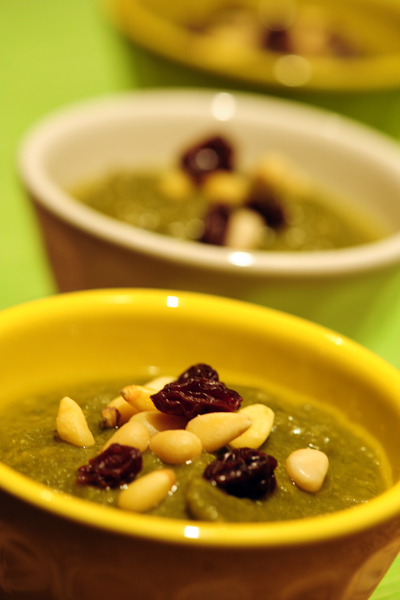
    This spinach and chickpeas soup adapted from Mark Bittman has become one of our favorites and I have been serving it about twice a month (spreading it for a few meals, that is...). My children call it "la soupe verte" as opposed to "la soupe orange" (the Carrots/Sweet Potatoes Curried Soup, which by the way has been very much appreciated among a lot of my friends, relatives and other guests so try it if you have not already!!).  Orange is a sure deal (ie, no "encore de la soupe!!!).. verte is also good because they know that they'll get to eat some raisins and pine nuts with it.  That makes it fun for them and together with a fresh/toasted piece of bread and they are happily fed!
    I have yet to work on having them like some of the other soups I made (cauliflower velouté, red lentils soupe, soupe a l'oignon, etc. ) but that never qualified for a "elle est bonne ta soupe, maman!!" And since soup season is far from being over in our family, I have a few more weeks to improve or to improvise! I bought a bag of yellow split peas at the Indian store the other day... that might be part of the next soup chez nous! Who knows it might well become "la soupe jaune"!! Any good colorful recipe/idea to share when it comes to soupe? Bon appétit!


    Ingredients
    -  1 or two garlic cloves
    -  1 small onion, chopped
    -  About 3 cups of cooked chickpeas (canned are fine); plus a few to garnish
    -  1 pound of spinach (frozen is fine)
    -  1 carrot (optional)
    -  olive oil, salt and pepper to taste
    -  Golden raisins and pine nuts to garnish


    • In a large pot, saute the garlic and onion in olive oil
    • Add the chickpeas, spinach and carrot and cover with water (about 1 liter or 4 cups)
    • Cook until the spinach are fully cooked
    • Using an immersion blender, puree; add water if you feel that it's too thick.
    • Add salt and pepper to taste
    • Serve with raisins, pine nuts and a few chickpeas.
    My comments
    • I have added curry powder to spice it up a little bit

    Wednesday, February 1, 2012

    Squid with Saffron Rice - Riz Safrané aux Calamars

    Afriend of mine who lives in Italy gave me an Italian cooking book as a wedding present (that's almost 11 years ago!!!) Flipping through the pages recently in search for new ideas, I realized how little I knew about authentic Italian cuisine beyond the not-so-Italian dishes that are served here (or in France). It led me to wonder about Spanish food.  When it comes to Spanish cuisine, I was even more ignorant beyond the tapas, churrios, paella and jamon iberico.... . Strange in a way when you realize that Italy and Spain border France but despite this geographic proximity developed very different cuisines.
    One of the spices I wrongly-I-suppose (90% of the world production apparently comes from Iran although in the US, I was surprised to learn that it is still produced in the Dutch Lancaster county (about 2hrs away from Philadephia)) associate with Spain is saffron. My mother used to have tiny tiny red boxes of saffron when we were kids and I remember loving to play with them...(as part of my love to reorganize the spices box!!) but I never realized the value of these boxes until as adult I had to face the shocking price of saffron. Tiny treasure boxes as saffron is indeed one of the most (if not the most) expensive spice in the world!

    I generally cook saffron with seafood and rice (like we do in the South of France in the fish-soup Bouillabaisse) and since I have been trying to serve different seafood to my family recently, I thought that it would be a great idea to use squid instead of white fish in this dish.
    I served it to my family the other day and my husband compared it to a Spanish paella (which he enjoys more than a risotto) explaining to our children what paella is really about, where it is eaten, what saffron is about, etc.. Yet the kids were more intrigued by the squid (I had asked to have tentacles as well as the head!!) which led us to talk about these little sea creatures too!!
    To be honnest, this dish has nothing to do with a paella (no chicken, no shrimp, no mussels, no tomatoes) but yet again, there must be a few different paella recipes in Spain! So why not? All that I know is that we all loved it and I know that I can now put it on the list of dishes that I know will score high with my family. So if you can afford it, purchase a little bit of saffron and try it out. You won't be financially richer but you will be culinary-wise...a little bit of Spain in your home. Because no matter how long I live in Philadelphia, I will have a hard time associating Saffron with the nearby Dutch county! Bon Appétit!

    Ingredients:
    - 1 pound squid cleaned and cut into pieces
    - White rice (about a cup)
    - 1 red bell pepper
    - 1 medium onion, thinly sliced
    - 1 clove of garlic, crushed
    - a few stigma of saffron
    - a cup of dry white wine (optional)
    - 1 cup of green frozen peas
    - Salt and pepper to taste
    - Olive oil for sauteeing


    • In a large pan, saute the onion, garlic and bell pepper in olive oil
    • Add the rice and saute it until fully coated with olive oil
    • Add 1 cup of white wine and two cups of water
    • Add the saffron
    • Bring to a boil and then simmer until rice is fully cooked, stirring often and adding extra liquid if needed.
    • Just before serving, add the frozen peas
    My Comments
    • There are definitively different grade/quality of Saffron. I purchase the small Spanish Saffron from Trader Joe's. It might not be the best Saffron ever but it suits my needs and budget.
    • If you like risotto-like dishes, you could use Arborio (short grain) rice. I would not use brown rice in this dish since the squid are already a little bit chewy....

    Sunday, October 16, 2011

    Tuna and Salmon Ceviche


    Until sushis became widely popular, it was really rare to eat raw fish in France. Except for their steak tartare or fresh oysters, French people don't really eat raw proteins. Sure, you'll always find one person who likes to gobble one fresh raw egg (aka gober un oeuf) but even if I can eat pretty much anything and I LOVE soft-boiled eggs, I can't gober un oeuf. Beurk...
    The first time I ate ceviche was while traveling in South America (that's where it's originally from in case you did not know). My husband having lived in South America as a child enjoyed ceviche so we ordered shrimp ceviche one evening in Chile. Shrimp or fish is generally marinated in lime which "cook" them so you never have that feeling of eating raw shrimp/fish like you would if you had sashimi in a Japanese restaurant.
    Like most recipes, every country in South America (at least the coastal ones with the exception of Argentina where fish is not mainstream at all),  has its own ceviche recipes. Back when we lived in Ithaca we were invited for dinner to our Ecuatorian friends' house (she really is from Argentina but being married to an Ecuatorian she had gotten used to eating ceviche, the Ecuatorian way that is). And for us who expected a raw-lime marinated-type of dish, we were really surprised to be served a shrimp soup  that had been cooked in a ketchup-based sauce topped with popcorns!! It was nonetheless very good but as you can expect, my husband who has very specific narrow ideas of what a ceviche should taste like, was disappointed! Not that he did not enjoy the dish (he liked it a lot) but this was not the ceviche he was expecting. And when it comes to food, expectations (especially the ones referring to one's mother's cooking) can be extremely dangerous! (My advice: never-ever dare trying to serve a dish that has been served to your spouse by his mother while growing up! No matter how good your recipe is, his expectations will kill your dish! The only solution, call it something totally different!!!)

    Here is my brother's tuna-and-salmon ceviche recipe. He made is for us back in August (and yes, my husband liked it despite the fresh ginger and soy sauce ; his expecations were different since no shrimp were served!)  I made it again last weekend when we had a nice day that gave us a Summer day in October. It's definitively not a recipe I'll cook in the middle of cold weather... but something to keep in mind for next Summer, unless you live in the Southern hemisphere or in a climate where it feels like Summer everyday! Lucky you! Bon Appetit!

    Ingredients:
    - 1 pound of ahi tuna
    - 1 pound of fresh salmon skin off
    - fresh ginger : the quantity depends on your taste: I tend to like it a lot so I use a lot ; I grate about 1 inch.
    - soy sauce to taste
    - green onion (2) chopped
    - 1 small red bell pepper, diced
    - a few capers (optional)
    - one mango
    - 4 limes, juiced


    • Prepare the marinade: mix the pepper, together with the mango, green onion, capers. Mix in lime juice, fresh ginger and soy sauce. 
    • Cut the salmon and tuna in tiny cubes.
    • Pour the marinade on the fish and put in the fridge for 30 minutes. The longer you'll marinate the fish, the more "cooked" it will be.
    My Personal Comments
    • If you are planning on serving it to kids (or adults who can't chew on fresh ginger), dice the ginger instead of grating it and remove the ginger pieces before serving.
    • You could replace the pepper with a cucumber (if easer to digest). The idea of the pepper is to add "crunchyness" to the dish.

    Thursday, July 28, 2011

    Black Olives Tapenade


    I love olives.  I have always loved them and the story goes that for my two-year birthday a friend of my parents' gave me two olive jars. I was in heaven and did not bother playing with the doll I received as a gift! (hint: if you don't know what to bring to our house, good olives are always welcome!).
    Being in France makes it cheaper to eat olives. Some of them grow just in your backyarkd if you live in the South of France... or just across the border in Italy or Spain or a little bit further away in Greece (but Greece is closer to Paris than San Francisco is to Philadelphia)...
    Since we eat olives a lot in our family, my children have developed a good taste for them, including the spicy ones that we find at the supermarket.
    My love for olives made me want to have a perfect Tapenade recipe to eat as an appetizer for our weekly aperitifs or just together with a nice salade composee for nice and relaxed Summer dinner. One that would not be loaded with salt and additives. One that would be smooth enough but with tiny bits of olives. This is not easy. I am not even sure this recipe is my favorite one. Why? Because I have not found the right olives to put into. I tried the cheap version with canned olives (yeah, canned, I know, I know) and it was tasteless. I then went the other extreme where I used cured black olives and that was way too strong (and too salty). Good thing I am in France these days, I'll be able to go and pick the ones I think would make a tapenade perfect. In the meantime, don't complain not to be in France (well, you can), but try to find the right olives near you and don't be disappointed if it does not work out great the first time. Trust me, when it comes to olives, you are on for major discoveries...I am still discovering some and can't wait to try new ones in the years to come!! Bon Appetit!


    Ingredients:
    - 1 cup of black pitted olives (Kalamata would do)
    - 1 clove garlic (you could put two if you like it a lot)
    - 2 Tbs olive oil (a good one)
    - 1 Tbs lemon juice
    - 2 anchovies (optional)
    - 1Tb capers (I put 2 because I like them a lot too)
    - Salt


    • Put all the ingredients in a blender and blend until reaching desirable consistecy.
    • Add salt if needed (it will depend on the capers/anchovies).
    • Refrigerate
    • Serve with crackers, toasted bread.

    Monday, July 4, 2011

    Gazpacho

    As I was driving the kids to school one day, we were behind a camion citerne (tanker) and everytime we are behind one, we play this game of trying to guess what it is inside the tank. I started that game a long time ago, trying to keep my children quiet in the car:  it was also a way to make them aware of how things move from point A to point B depending on their physical form.
    Since we have played this game many times now (too many trucks on the Philadelphia highways!!), my daughter knows and start with the usual "orange juice, olive oil, water,". Picking up the game, my son started to say "apple juice, milk"... and then "beer". I started laughing! Soon enough he and his sister were saying "white wine, red wine, pisco!" We all started laughing...I felt that a stranger listening to this conversation could have thought that my husband and I are such heavy drinkers that our kids know all the names of the beverages we drink!! Yes, they tried a drop of Champagne at their christening; yes, they tried a drop of beer and wine; but no, we are not heavy drinkers! We just happen to enjoy a drink here and there (especially on our Friday aperitifs) and my kids just happen to be great observers...

    Since it's hot these days, here is a cool non-alcoholic soup for you and your family. My children enjoy eating this gazpacho because they really get to chose the toppings they can eat it with! Worth the extra time to chop extra veggies to put on the table... Bon Appetit!

    PS: And for those of you who had never had Pisco (a drink originally from Peru but which we discovered in Chile), here is a NY Times article I recently came across! We generally drink it with just lime, crushed ice and powdered sugar... but who knows, in a few years, my kids might add a few cocktail names to their "tanker list!"
    Ingredients:
    - 2 large cans of whole peeled tomatoes (good quality)
    - 2 fresh tomatoes, skin remove
    - 1 cucumber
    - 1 red onion
    - 1 clove garlic

    For garnish:
    - Bell peppers
    - Onion
    - Croutons
    - Cilantro/basil/chive
    - Cucumber
    - Tabasco
    - Salt, black pepper


    • In a bowl, blend the canned tomatoes (including liquid), the fresh tomatoes, cucumber, 1/2 onion and garlic. 
    • Chill for a few hours
    • Serve cold.
    My Personal Comments:
    • If I am able to plan ahead, I refrigerate the canned tomatoes overnight so that they are already chilled when I blend them with the other ingredients.
    • If can not plan, put the bowl in an ice-bath while refrigerating it. 
    • To peel the fresh tomatoes, drop them for 30s in simmering water.

    Thursday, April 14, 2011

    White Beans and Sausage Stew

    Patrimoine génétique... I am not talking (again) about GMOs (but yes, try to avoid them as much as possible!!)... but about the inherited diseases that we might face one day for just being the children of our parents'. I never realized how important it is until we started talking about cholesterol in my family (they speak arthritis in my husband's!!). I won't go into much details but having had a blood work done recently, I had the unpleasant surprise to discover that I, too, have a cholesterol problem, albeit minor at this stage.
    But I am not even 40! And I eat quite a healthy diet, exercise, don't smoke, drink a glass of red wine  (or Pisco) here and there, and I am definitively not overweight!! Quite unfair, I want to say! Fair or not fair, that's what genetics is about...and we have to accept it...
    So what do I do to avoid having to take medication? The only adjustments I could make are eating less cheese (but considering the price of good cheese here, it's not like we eat triple-cream cheese every day!!), banning red meat while increasing fish such as maquerel, salmon and other omega-3-loaded fish, and reducing the amount of butter and eggs I use when I bake. Quite a challenge, especially when it comes to baking! That said, I feel that, as for anything else, I'll just make compromises: eating a very low-cholesterol diet to be able to have a nice piece of cheese once-in-a-long-while. Voila!

    The other thing that I worry is how much will my children inherit: between le cholesterol de maman (dad's needs to be checked btw because he claims that he does not have any but I yet have to see the results!!) and l'arthrose de papa, I just hope that genes dilution won't make our children suffer from any of it. Time will tell...
    In the short term, this is one of the few recipes I'll stop eating for a while (or at all), well at least with the sausage option.  This is nothing like a French cassoulet but since we don't have the right beans nor the right meat to make a real cassoulet in Philadelphia, this is a nice proxy. Which makes me think that I won't be eating the canned cassoulet we brought back from France last Summer. Anybody wants to come for dinner? Bon Appétit!


    Ingredients
    - Great Northern White Beans (preferably dry&soaked but canned will do to)
    - 1 small onion, minced
    - 2 garlic cloves, minced
    - a few carrots, cut into small pieces.
    - Fresh thyme
    - Cumin seeds (1/4 ts, more if you like it a lot)
    - Kielbasa sausage (enough to feed your family; more if you want leftovers)

    • In a thick-bottom pot (like a cast-iron), saute the onion and the garlic in olive oil.
    • Add the cumin seeds , the carrots and coat with olive oil
    • Add thyme.
    • If you are using canned beans, pour the beans into the pot, add the sausage and cook at low temperature for 15-20 minutes (you only want the carrots to be cooked)
    • If you are using pre-soaked beans, you will want to cover the beans with water, add the sausage and cook at low temperature for about 1h30 (or until the beans are tendered). 
    My Personal Comments
    • You could add a few pieces of bacon or ham or even pork butt into the dish for extra cholesterol flavor!
    • Don't hesitate to make more because it makes great leftover!